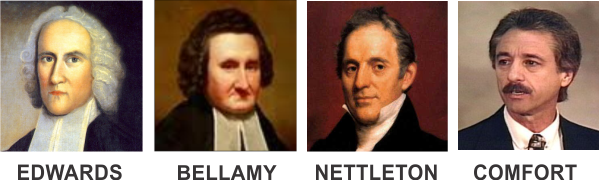
Ray Comfort is the most famous minister today to use Law Works to enlighten sinners to their hopeless condition, and their desperate need of supernatural regeneration and the indwelling of the Holy Spirit.
Ray Comfort is a voice crying in the evangelical widerness because of the widely trusted heresy of Decisional Regeneration.
Few ministers even know what Law Works is, much less use it with sinners. Tragically, they assume a sinner is saved if they sincerely repeat a salvation prayer. Follow-up statistics show that 90% of people who repeat a salvation prayer have no Biblical evidence of being saved.
No doubt Judas was sincerely sorry when he repented of betraying Christ, but proved he wasn't saved when he killed himself. There are two Greek words for repentance. The Greek word used to describe the repentance (sorrow, regret) of Judas is metamellonai, which doesn't require saving faith. Like Judas, most seekers are sorry for their sin, but that's not enough to be considered saving repentance. The Greek word for saving repentance is metanoia (reverse direction), which requires saving faith to stop sinning, a fruit of supernatural regeneration.
Judas was what Jonathan Edwards, Joseph Bellamy and Asahel Nettleton called an evangelical hypocrite. Law Works was used by New Light Calvinists to help evangelical hypocrites recognize their inability to please God and their utter need of the supernatural change that takes place when God saves someone.
Here is a good description of how Isahel Nettleton saw Law Works in his ministry taken from page 82-83 of J. F. Thornbury's excellent book, God Sent Revival:
Nettleton's engagements in the war against evil were, of course, in the front line of battle. He looked upon the problems of mankind as primarily spiritual rather than intellectual. Asahel was not interested in the discussion of theology merely as abstract points of speculation. He viewed the world of ideas as an armed camp, where hostile forces continually vie, not only for the minds, but for the souls of men. He saw sinners, not as victims of intellectual kidnap, but as willing slaves and friends of Satan.
Content to leave the cerebral discussions of philosophy to the musty halls of rationalism, he sallied forth into the heat and fury of spiritual combat and won men to the cause of Jesus Christ by art and by force. His favorite authors were those who continually showed the practical application of biblical truth, such as Andrew Fuller, John Bunyan, Edwards, and Bellamy.
Because of his burning desire to lead men to Christ, Asahel was, of necessity, a student of theology in its practical, or experimental aspects. Religious errors were not only contradictions of the word of God, but the shackles which held men in spiritual bondage. Any doctrine which tended to secure men in their sins, or delay their laying hold of the gospel, he stiffly resisted.
He opposed Arminianism, because it caused men to rely on themselves rather than God. But he also stood against hyper-Calvinism because it tended to take away the urgency of sinners to submit immediately to the claims of Christ.
Nettleton's views on the nature of conversion were very dogmatic and carried him at times into debate, even with Calvinist divines. He objected, for example, to the famous works of Walter Marshall, The Gospel Mystery Of Sanctification, because it appeared to foster a false and presumptuous assurance. Marshall's position seemed to Asahel to encourage men to believe they were converted “while they had no evidence of a change of heart”. Marshall's book was highly praised by such outstanding divines as the Erskines of Scotland, James Hervey, and Thomas Chalmers.
The burden of this book was professedly to lead men to renounce any form of works for salvation and to exhort sinners to rely upon Jesus for salvation. It made (saving) faith to consist of the belief that one's sins are pardoned. Joseph Bellamy took issue with the thesis of this book and sought to refute it in his Theron, Paulious, and Aspasio, because it seemed to leave no room for evangelical humiliation as a condition of salvation and had antinomian tendencies. Of course Nettleton studied Bellamy and was influenced by this treatise.
The fact is there was enough Hopkinsianism in Asahel to cause him to view Marshall's concept that (saving) faith is trust in Christ as having too much self-interest in it. It failed to meet the vital Edwardian test of a view of the essential glory of the Redeemer.
He met a lady at Upper Middleton who was reading Marshall's book, and she remarked, “If I dared believe that book, I should think I was a Christian”. Asahel answered forthrightly, “I am glad you dare not believe it”.
Marshall was a sort of Puritan forerunner of the Keswick movement, with its position that the life of the Christian is one of blissful, cloudless trust in Christ and repose in God's mercy. Bellamy, Hopkins, and Nettleton were of the old rugged New England school, who believed that assurance does not normally come easily.
No one, in their view, had any right to claim salvation unless he sees in himself positive evidence of a change of heart, the debate between these two camps has a modern counterpart in the controversy over whether conversion includes submission to the Lordship of Christ and whether repentance, as distinguished from (saving) faith, is a condition of salvation. Men of distinction are on either side.
Whatever one may think about Asahel's ideas on conversion, none can deny that he had the interests of the souls of men in mind. If he wounded the unconverted too deeply and held too high a standard of conversion, which is debatable, many would say that modern evangelists tend to go too far in the other direction, in rushing to give relief to the sinner at the expense of sound principles of counsel. Rough as they seem, Nettleton's strict views on conversion are hard to challenge in the light of the permanence of his converts.
Before Scottish Common Sense Realism replaced the New England theology of Edwards as the premier salvation theology, all New Light Calvinists used Law Works. Law Works are mentioned as an integral part of Joseph Bellamy's stages of the evangelical hypocrite - it's a succint summation of Jonathan Edwards’ description of the evangelical hypocrite in his book Religious Affections:
From what has been said, we may easily see the falseness
of the evangelical hypocrite's faith, who, although he makes a
much greater show, and is more confident, yet has not a jot
better foundation (than sinners that never had any religious affections).
1) HE MAY EXPERIENCE LAW WORKS
He has been greatly awakened, perhaps,
and terrified, and seemingly brought off from his own righteousness,
and humbled, and then has received great light and comfort,
and has had any an hour of joy and ravishment. For thus
was the case:
2) HE MAY EXPERIENCE RELIGIOUS AFFECTIONS
In the depth of his darkness and sorrow, light
shined all around him ; and, to his thinking, he saw heaven
opened and the Lord sitting upon his throne, and Christ at his
right hand, and heard those words, - Come, ye blessed of my
Father, inherit the kingdom prepared for you from the foundation
of the world. Be of good cheer; thy sins are forgiven.
Fear not, little flock: it is
your Father's good pleasure to give
you the kingdom. O thou afflicted, tossed with tempests, and
not comforted, behold, I will lay thy stones with fair colors,"
3) HE MAY EXPERIENCE REVELATIONS
Or, it may be, he saw Christ on the cross, with his blood
running from his side, and hands, and feet: or, perhaps he saw
a light in his chamber.
4) HE MAY EXPERIENCE A FEELING THAT A PARTICULAR SCRIPTURE APPLIES TO HIM
(this was to be the undoing of the New Light Calvinist Decision for Christ after the Civil War - see The Evangelical Bait and Switch)
It may be, he had one scripture, and,
it may be, ten or twenty going, until he was as full as he could
hold, and even ready to cry, -'Lord, stay thy hand.'' As to all
these things, there is an endless variety; but, in the following
particulars, there is a greater agreement. First. They have a
discovery of Christ's love to them in particular; that he died
for them in particular; that their sins are pardoned, etc. Second.
The essence of their first act of faith consists in a firm persuasion
that their sins are forgiven; that Christ died for them
in particular, or the like.
EVERY ONE OF THESE EXPERIENCES CAN COME FROM A CARNAL HEART MOTIVATED BY SELF LOVE
All their after discoveries and after acts of faith are of the same nature with the first to the
fourth. This faith, from a principle of self-love, naturally fills
them full of joy, and love, and zeal, and lays the foundation of
all their good frames, and of all then religion.
5) AFTER THEY HAVE RETURNED TO THEIR OLD CARNAL SELF, THEY THINK DOUBTING THEIR SALVATION WOULD BE THE GREAT SIN OF UNBELIEF
Doubting the goodness of their state, WHEN they are dead and carnal, is,
in their account, unbelief, and a great sin, and to be watched and
prayed Against, as a thing of the most destructive tendency.
Now, some, who have a few discoveries, do, in a few months,
lose all their religion, and come to feel and live much like
the rest of the world. Others hold out longer. Some, after
they have lain dead one, two, three, five, or ten years, just
as it happens, will have what they call a new discovery, and
be as full as ever : while others continue in their irreligious
courses.
And here I may observe— That the greater discoveries,
as they call them, they have, the more proud and conceited
they are, and the more do they want to have all the town admire them.
It doesn't matter if you're Arminian or Calvinist or Restorationist...you can prevent false conversions. The problem isn't telling people to immediately repent and believe on the Lord Jesus Christ...the problem is telling people they're saved because of something they've done. Faithful Evangelical ministers examine seekers for Biblical evidence of supernatural regeneration and the indwelling of the Holy Spirit. Here are five evidences God has saved you.
1) You are Obedient to God's Word
2) You have Power Over Sin
3) You are Led of the Holy Spirit
4) You Bear Fruit of the Holy Spirit
5)
You Love God's Word and God's People
It's impossible to force or bribe God to save you, but a necessary result of God saving you is you'll bear good fruit. Whenever God supernaturally regenerates a heart and fills someone with the Holy Spirit, he will want to please God with a life of faith, working through love (Galatians 5:6). If you think you are saved, look for Biblical evidence. |