
How The Restoration Churches
Relate to
the
Heresy of
Decisional Regeneration
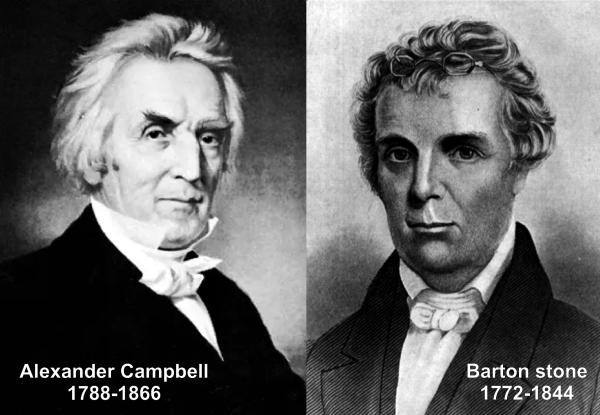 |
Barton W. Stone (1772-1844) and Alexander Campbell (1788-1866) were both educated Presbyterian ministers who left the Presbyterian Church and believed they were "restoring" the first century way of salvation. They called themselves, "Restorationist", because they believed they were part of a movement of God to restore the Church to its original form, with no denominational rules or creeds, and only the Bible as their guide. Both ceased to believe in the Presbyterian view of election, but were radically different in their view of the Holy Spirit and salvation. For example, Stone believed the Holy Spirit was an immediate force in supernatural regeneration and indwelling saints, while Campbell had a Scottish Common Sense Realism view of regeneration as merely the tipping point of the understanding. Campbell believed the Holy Spirit was limited to quickening Scripture to the understanding, but Stone maintained his view that the miraculous work of the Holy Spirit was the way people are saved. At the end of his life, Stone described how the Holy Spirit affected multitudes when the gospel was preached at Presbyterian Sacramental meetings: "With astonishment did I hear men, women and children declaring the wonderful works of God, and the glorious mysteries of the gospel ... After attending to many such cases, my conviction was complete that is was a good work - the work of God; nor has my mind wavered since on the subject. Much did I then see, and much have I seen since, that I considered to be fanaticism; but this should not condemn the work. The Devil has always tried to ape the works of God, to bring them into disrepute. But that cannot be a Satanic work, which brings men to humble confession and forsaking of sin - to solemn prayer - fervent praise and thanksgiving, and to sincere and affectionate exhortations to sinners to repent and go to Jesus the Saviour. I am always hurt to hear people speak lightly of this work. I always think they speak of what they know nothing about". In 1832, Stone and Campbell officially joined forces. Campbell's Disciples merged with Barton Stone's Christians in Lexington, Kentucky. It was symbolized by a handshake between Barton Stone representing his Christians and "Raccoon" John Smith representing Campbell's Disciples. Smith was the most famous Campbellite preacher. Smith boasted to his wife, that in just a few months, he had "baptized 700 sinners and capsized 1500 Baptists". In the Baptist North District of Kentucky, 18 of the 26 Baptist churches converted to Campbellism. Because Campbell denied supernatural regeneration and the indwelling of the Holy Spirit, he told Baptists all they had to do to be saved was be baptized in water. At this time, Baptists all believed in supernatural regeneration and the indwelling of the Holy Spirit. Many Baptist Associations started to expel church members that associated with the Restorationist movement. You can read one of the Baptist Circular Letters that warned against Campbellism, published in July 1830. In the 1830's Alexander Campbell's Consistently Published view was one of the three Verbal-Restrictive theories in which the work of the Holy Spirit is imminent (restricted to, but fully available) in the Word of God. The means of salvation are therefore restricted to hearing and reading scripture. Campbell wrote, “Whatever the word does, the Spirit does; and whatsoever the Spirit does in the work of converting men, the word does.” But when confronted with this quote from The Christian System in a debate in 1843 with Nathan Lewis Rice, Campbell said he was NOT a strict “Verbal-Restrictivist”, and that he believed in some way the Spirit quickened scripture in the heart, which should have silenced Rice, because that sounds like the Scottish Common Sense Realism taught at Princeton Theological Seminary. Rice would have called it the "truth-impression" theory. Campbell's church called it the Verbal-Augmentative theory. For more on the three Verbal-Restrictive Theories of the Holy Spirit, click here. |
 |