
How "Evangelical Hypocrites"
Relate to the
Heresy of Decisional Regeneration
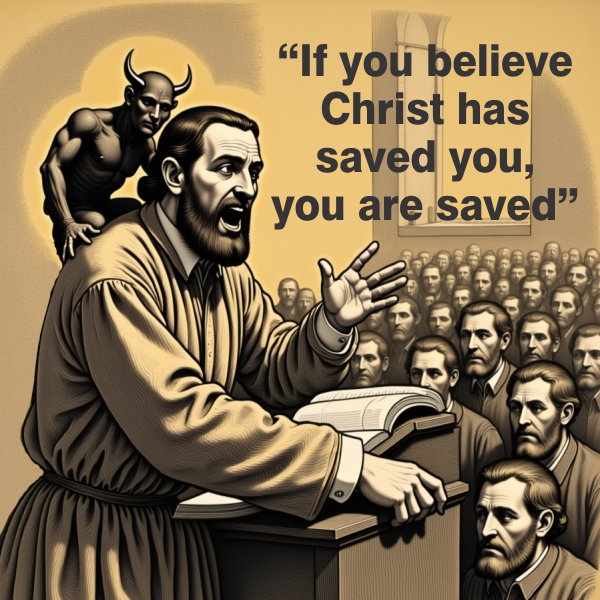 |
During the First Great Awakening, Evangelical ministers used the term "evangelical hypocrite" to identify church-goers and church members who attended evangelical churches, but were not born again. They also called them "gospel hypocrites", "formal professors" or "carnal professors", having a "form of godliness, but denying the power" (2 Timothy 3:5). A large portion of any church are those who faithfully participate in all the outward, public rituals of Christianity, but remain unregenerate and therefore, are spiritually dead.
In every age, Christian churches have been made up of born again Christians and Christians that are not born again. In the early Church, the born again Christians were called Initiates because they had been initiated into the mysteries of the Church including the partaking of the Lord's Supper. In the early Church, the Christians that were not yet born again were called Catechumens (Greek for "one who is taught"), who had not yet been baptized in water and not allowed to partake of the Lord's Supper.
Most Evangelical ministers continue the tradition by distinguishing between born again Christians and non-born again Christians when it comes to the Lord's Supper. They quote the Apostle Paul: "whosoever shall eat this bread, and drink this cup of the Lord, unworthily, shall be guilty of the body and blood of the Lord. But let a man examine himself, and so let him eat of that bread, and drink of that cup. For he that eateth and drinketh unworthily, eateth and drinketh damnation to himself, not discerning the Lord's body." ( 1 Corinthians 11:27-29).
The Greek word translated "unworthily" is anaxios, which means "not axios". The word axios is where we get our English word "axiom", which means "self-evident truth". If you do a study of where axios is used in the New Testament, you'll find it relates to proof of salvation. "Then Paul and Barnabas waxed bold, and said, It was necessary that the word of God should first have been spoken to you: but seeing ye put it from you, and judge yourselves unworthy of everlasting life, lo, we turn to the Gentiles" (Acts 13:46).
In 1695, John Locke (1632-1704) published his The Reasonableness Of Christianity, in which he listed a few minimum requirements for Christian salvation that would later be called "bare faith".
Evangelical ministers categorically condemned it as an endorsement of state churches that did not teach "ye must be born again" as necessary for salvation.
Locke's "bare faith" requirements: You must believe Jesus is the Messiah and that He was raised from the dead. Locke, before the end of the book, says a person who believes these things will live a life according to Jesus' moral teachings, but that, of course, would describe almost every person who attends a state church, even the ones who aren't born again. Locke told every "evangelical hypocrite" who attends church, they didn't need to be born again to be saved.
Here is what Joseph Bellamy wrote about the evangelical hypocrites in the First Great Awakening:
1) HE MAY EXPERIENCE LAW WORKS
He has been greatly awakened, perhaps, and terrified, and seemingly brought off from his own righteousness, and humbled, and then has received great light and comfort, and has had any an hour of joy and ravishment. For thus was the case:
2) HE MAY EXPERIENCE RELIGIOUS AFFECTIONS
In the depth of his darkness and sorrow, light shined all around him ; and, to his thinking, he saw heaven opened and the Lord sitting upon his throne, and Christ at his right hand, and heard those words, - Come, ye blessed of my Father, inherit the kingdom prepared for you from the foundation of the world. Be of good cheer; thy sins are forgiven. Fear not, little flock: it is your Father's good pleasure to give you the kingdom. O thou afflicted, tossed with tempests, and not comforted, behold, I will lay thy stones with fair colors,"
3) HE MAY EXPERIENCE REVELATIONS
Or, it may be, he saw Christ on the cross, with his blood running from his side, and hands, and feet: or, perhaps he saw a light in his chamber.
4) HE MAY EXPERIENCE A FEELING THAT A PARTICULAR SCRIPTURE APPLIES TO HIM
(this was to be the undoing of the New Light Calvinist Decision for Christ after the Civil War - see The Evangelical Bait and Switch)
It may be, he had one scripture, and, it may be, ten or twenty going, until he was as full as he could hold, and even ready to cry, -'Lord, stay thy hand.'' As to all these things, there is an endless variety; but, in the following particulars, there is a greater agreement. First. They have a discovery of Christ's love to them in particular; that he died for them in particular; that their sins are pardoned, etc. Second. The essence of their first act of faith consists in a firm persuasion that their sins are forgiven; that Christ died for them in particular, or the like.
EVERY ONE OF THESE EXPERIENCES CAN COME FROM A CARNAL HEART MOTIVATED BY SELF LOVE
All their after discoveries and after acts of faith are of the same nature with the first to the fourth. This faith, from a principle of self-love, naturally fills them full of joy, and love, and zeal, and lays the foundation of all their good frames, and of all then religion.
5) AFTER THEY HAVE RETURNED TO THEIR OLD CARNAL SELF, THEY THINK DOUBTING THEIR SALVATION WOULD BE THE GREAT SIN OF UNBELIEF
Doubting the goodness of their state, WHEN they are dead and carnal, is, in their account, unbelief, and a great sin, and to be watched and prayed Against, as a thing of the most destructive tendency. Now, some, who have a few discoveries, do, in a few months, lose all their religion, and come to feel and live much like the rest of the world. Others hold out longer. Some, after they have lain dead one, two, three, five, or ten years, just as it happens, will have what they call a new discovery, and be as full as ever : while others continue in their irreligious courses. And here I may observe— That the greater discoveries, as they call them, they have, the more proud and conceited they are, and the more do they want to have all the town admire them.
 |