RETURN TO MAIN PAGE BUTTON

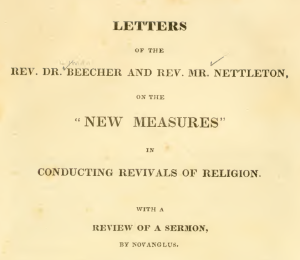
How Letters On The New Measures
Relates to the
Heresy of Decisional Regeneration

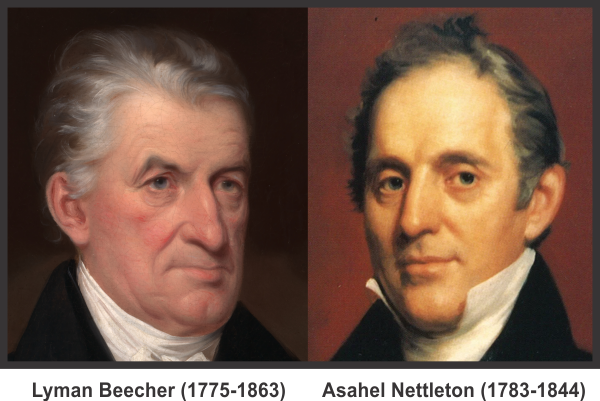
 In 1827, Lyman Beecher joined with Asahel Nettleton
to condemn the "New Measures" associated with
Charles Finney


 To read the document, click here

The issues dealt with in this document are still relevant today. Although Charles Finney didn't do many of the things he was accused of, modern ministers can compare themselves to the accusations against him, and benefit from the recommendations. 

The seven main ojections of Asahel Nettleton to the "New Measures" associated with Charles Finney:

1) Calling out by name ministers that objected to the use of "New Measures".
 
There is a natural animosity between established ministers and so-called evangelists that cause church members to doubt their salvation. 
It will always been true that established church ministers will tend to resist change, because they believe adequate means of grace are available in church participation. Telling chutch members "repent" and "ye must be born again" automatically questions whether the establish church means of grace are sufficient for Biblical salvation to take place.

Nettleton himself made mistakes, and occasionally "went to far". He did not condemn Doctor McAuley, for something others would consider outrageous. From his Memoirs:  "About this time, one of the students was called into the eternal world. He was laid out in Dr. McAuley's study. The Dr. was anxious to improve this solemn providence to the best advantage. He assembled the students around the lifeless remains of their departed friend, and conversed and prayed with them in the most solemn manner. A number of them engaged to attend to the subject of religion in earnest. From that time, many of the students became deeply impressed with a sense of their lost condition. For them were appointed meetings of inquiry. And in this very room where they lately beheld the breathless corpse of their young companion, and where I am now writing, was witnessed a scene of deep and awful distress. About thirty of the students are brought to rejoice in hope. The revival is now very powerful in the city. Such a scene they never before witnessed".
To read this in Nettleton's Memoir, click here and turn to page 96

2) Allowing females to pray with males.

At this time in history,  1 Timothy 2:12 was thought to mean a women could not testify of what God did for them in a church service. It was allowed in a private setting, as Nettleton records with thankfulness to God in his Memoirs: " We visit by appointment, and make a number of visits in a day at a given hour. We sometimes meet ten or fifteen, and sometimes thirty at once. We converse a little with each one, speak a word to all in general, pray and pass on to another circle, and so we spend our time. Our visits are generally short, except one which will never be forgotten. This was August 25, at 2 o'clock, P. M., at the house of Mr. B.

We entered the house at the time appointed, and found about twenty persons sitting around the room in pensive silence. All had been more or less anxious for a number of days, and one was in awful distress. This one I addressed more particularly, and urged the duty of immediate repentance, not without some hope that relief would be obtained on the spot ; for I felt sure that this state of feeling, could not long be sustained.

While pressing the conscience of this sinner, I found that this distress had spread nearly throughout the circle. I detained them the usual time, and advised them all to retire home to their closets. Some started and went out of the door, and others sat still with heavy hearts. Very soon, Emily returned, exclaiming, '0, I cannot go home, I dare not go. I shall lose my concern. What shall I do ? ' and threw herself down in a chair, and her head on the table, in the deepest agony. All at once she became silent, and gently raised her head with a placid countenance, and was heard to say in a mild tone of voice, ' 0, I can submit, I can love Christ. How easy it is ; why did I not do it before.'

We sat in silent amazement. Every word sunk deep into our hearts. We felt the conviction that God was there. She seized her next companion by the hand, and with all the tenderness becoming a fellow sinner, began to press those very truths, which had so distressed her own heart, the duty of immediate repentance and submission to God. Every word became an arrow.

I felt that the work was taken out of my hands, for I perceived that God had made her the most powerful preacher. 'All at once, A. became silent, and lifted her head with a countenance beaming with joy. ' The Saviour has come—O how happy.' This sent fresh alarm through every heart. And now A. and E. unite heart and hand, and begin with H. who had been in deep distress for some time. They urge with all the tenderness and firm decision of those who had felt the conviction, the necessity, and reasonableness of immediate repentance, and submission to God.

The subject pressed harder and harder and harder still, when all at once, H. was brought out of darkness into marvelous light. These three now unite heart and hand, and with one voice bear testimony to the same heart-rending truth that God is right and the sinner wrong. The time would fail me to finish the story of this visit.

We met at 2 o'clock, P.M., and were detained more than three hours. Suffice it to say, I never saw or heard of such an afternoon visit before, for the one half has not been told. At the close, we began to look about us to see, and inquire, what hath God wrought! We brought them into one circle. I said, is it possible ! This is too much ! Had I not seen it, I could not have believed it.

For nine of those who entered the room in deep distress, were now rejoicing in hope. The anxious ones had retired, and we were left in a circle of young converts, if they are not deceived. Not a hint had been given that one soul had experienced religion, or had any reason to hope. This was the feeling, It is right I should love and serve God, and this I intend to do, whether saved or lost.' Oh, it was a delightful circle, humble, tender, affectionate and joyful. They appeared like children of the same great family.

To read this in Nettleton's Memoir, click here and turn to page 114


3) Anger, wrath, malice, envy and evil-speaking is created by the New Measures, without a single conversion.

Subsequent testimony from persons who attending the cited church services paint the opposite picture. Nettleton himself, on page 14 of Letters On The New Measures, makes the following statement: "In the remarks which I have made, you will understand me. I separate between the efficacy of the measures adopted in the Western revivals, and the evils which have grown out of those measures. Of the former, I have no doubt".

Nettleton faced much criticism for calling people to immediate repentance. Here he speaks of some of his critics in his memoirs: "Those who have made light of revivals of religion, by calling them enthusiasm, fanaticism, and the work of the devil - especially those who have taken an active part in ridiculing the conviction and conversion of sinners, in the season of a revival—those who have called revivals by the hardest names, who have expressed the greatest contempt of them, and who have done the most to bring them into disrepute - persons of this description, have been the most frightful monuments of distress, that I have ever witnessed. They despair of ever becoming the subjects of that work which they have treated with so much contempt. We have sometimes heard the champion of infidelity expressing his horror for fear of having committed the unpardonable sin. I am acquainted with the names of persons, who have become perfectly deranged in consequence of their own opposition to the progress of revivals. Conscience, without any other accuser, has driven the enemy of revivals out of his reason into a state of settled delirium. The confession and fate of Judas, show the power of conscience, and stand recorded as a warning to the opposers of religion to beware".
To read this in Nettleton's Memoir, click here and turn to page 105


4) Young ministers denounce settled ministers.

This is a problem in all revivals of religion. Young ministers who believe the Holy Spirit is leading them to call backsliders to repentance, can easily denounce what they consider to be "the blind leading the blind".

George Whitefield, in the First Great Awakening, denounced ministers that he believed were unregenerate and spiritually blind. Here's a state church denunciation, saying Whitefield was gulty of "Encouraging a dependence on impulses and immediate revelations - Declaring, on slender evidence, people converted,' and others carnal and unregenerated”

To read this in Whitefield's Memoir, click here and turn to page 114


5) Praying for people in a church service by name.

This undoubtedly damaged the cause of Christ. Here's what Nettleton wrote: "The practice of praying for people by name, in the closet, and the social circle, has no doubt had a beneficial effect. But, as it now exists in many places, it has become, in the eye of the Christian community at large, an engine of public slander in its worst form. I should not dare, in this solemn manner, to arraign a fellow-sinner before a public assembly, without his own particular request, unless my expressions were of the most conciliatory kind. And no Christian minister, whatever his character may be, can adopt the practice without awakening the indignation of the world at large, and of Christians generally, against him. Much less can it be done by any body, and every body, who takes it into his head positively to decide the question, and to tell God and the world, that such and such persons are unconverted. I do not believe, whatever may be the effect upon the individual thus named,that God will regard such a prayer in any other light than as that of a proud, self-righteous Pharisee".
To read this in Letters On The New Measures, click here and turn to page 18

When a minister believes he's being led of the Holy Spirit, he can make mistakes that he regrets the rest of his life. What feels like an anointing can sometimes be pride. What feels like righteous indignation can sometimes be fleshly enthusiasm.

"If your brother sins against you, go and tell him his fault between you and him alone. If he hears you, you have gained your brother" ( Matthew 18:15). "If a man is overtaken in any trespass, you who are spiritual restore such a one in a spirit of gentleness, considering yourself lest you also be tempted. Bear one another’s burdens, and so fulfill the law of Christ. For if anyone thinks himself to be something, when he is nothing, he deceives himself" (Galatians 6:1-3).

6) Using flesh to counter flesh resistance.

Nettleton makes another salient point, whether or not Finney was guilty of the specific charge:  "If the preacher does not hold a balance between conscience and depravity, he can do nothing. The very fact that the unrenewed heart is so opposed to God and the Gospel, has by some been assigned as a reason for stirring up all its opposition. Whereas, aside from the simple exhibition of divine truths Paul adopted a method directly the opposite. If the vigilance of human depravity should exceed the vigilance of the preacher in his manner and measures, by this very means he will quiet the consciences of his hear ers. Regardless of his manner, Paul would have lost his hold on the consciences of sinners, and needlessly and wickedly have sent his hearers to a returnless distance from the Gospel. This made him exceedingly careful “lest he should hinder the Gospel of Christ." Since mankind will oppose, we should be careful not to put weapons of successful defense into their hands. While they oppose, we should be careful to keep their consciences on our side.
To read this in Letters On The New Measures, click here and turn to page 34

7) Not distinguishing between true and false conversions.

Finney examined penitents more critically than any evangellist. He used the BEST system in the Inquiry Room until he died. It was a disciple of D.L.Moody that started to use the BIST system exclusively in the Inquiry Room, and Billy Sunday eliminated the Inquiry Room altogether. 

Nettleton quotes Jonathan Edwards regarding True and False cionversions in the First Great Awakening: “It is likely ever to be in the church whenever religion revives remarkably, till we have learned to distinguish between true and false religion between saving affections and experiences, and those manifold fair shows, and glistening appearances, by which they are counterfeited ; the consequences of which, when they are not distinguished, are often inexpressibly dreadful. By this means, the Devil gratifies himself, by bringing it to pass, that that should be offered to God, by multitudes, under a notion of a pleasing, acceptable service to him, that is, indeed, above all things abominable to him. By this means he deceives great multitudes about the state of their souls; making them think they are something, when they are nothing; and so eternally undoes and not only so, but establishes many in a strong confidence of their eminent holiness, who are in God's sight some of the vilest of hypocrites. By this means Satan brings it to pass, that men work wickedness under a notion of doing God service, and to sin without restraint, yea, with earnest forwardness and, zeal., and with all their might. By this means he brings in even the friends of religion, insensibly to themselves to do the work of enemies., by destroying religion in a far more effectual manner than open enemies can do, under a notion of advancing it".
To read this in Letters On The New Measures, click here and turn to page 36

Today. evangelical ministers produce 90% false converts with the "repeat after me", salvation prayer method. Ministers do not care to distinguish between true and false conversions. The repeating of a "salvation prayer" is considered evidence of saving faith...this heresy is 100 times worse than anything ministers did in the 18th and 18th century revivals.


7) Ministering with a proud spirit without humility.

Whether Finney operated with fleshly pride or the confidence of being led of the Holy Spirit will ever be debated, but Nettleton makes a good point: "The eminently humble Christian is clothed with lowliness, mildness, meekness, gentleness of spirit and behavior, and with a soft, sweet, condescending, winning air and deportment. Humility has no such thing as roughness, or contempt, or fierceness, or bitterness, in its nature, which things are marks of spiritual pride; as are also invectives, and censorious talk concerning particular persons for their opposition, hypocrisy, delusion, pharisaism, and the like. Spiritual pride takes great notice of opposition and injuries that are received, and is often speaking of them. Humility disposes a person rather to be, like his blessed Lord when reviled, dumb, not opening his mouth. The more clamorous and furious the world is against him, the more silent and still will he be. Spiritual pride leads those who are reproached to be more bold and confident, and to go greater lengths in that for which they are blamed. Humility leads to improve the reproaches of enemies as an occasion of serious self-examination. Spiritual pride leads to a certain unsuitable and self-confident boldness before God and man. Humility leads to the opposite.
To read this in Letters On The New Measures, click here and turn to page 40


The fourteen main objections of Lyman Beecher to the "New Measures" associated with Charles Finney:.

We have in Lyman Beecher, a totally different perspective than that of Nettleton. While Nettleton wanted the Holy Spirit to aid and lead Finney with less pride and less self-assurance, Beecher
wanted Finney to stop getting conversions by using the law to show sinners their depravity.

1) The hasty recognition of persons as converted upon their own judgment, without interrogation or evidence.
Finney examined penitents for evidence of supernatural regeneration and the indwelling of the Holy Spirit more than any minister of his day. In this respect, he was very much like Nettleton. It is tragic that Nettleton didn't take Finney under his wing when Finney begged him for guidance. Nettleton recognized in Finney a fellow-worker for Christ, and blamed his imitators for most the abuses.

2) Severe and repelling mode of preaching and conversing with stupid and awakened sinners, giving a predominance to the awful and terrific traits of the divine character
and administration.
While Nettleton used the moral depravity of sinners to show them their need of Christ, Beecher was not gifted in that area. Beecher thought it best NOT show sinners how depraved they are. In this respect, Beecher sounds like the modern preacher who doesn’t use Law Works, but merely tells sinners that God loves them. Beecher writes, “The laws of the human mind are not to be outraged in preaching the Gospel, or the depravity of the heart needlessly roused and brought out into virulent action against man and and though those who themselves were exercised in this dreadful manner, are apt to imagine that all must feel just as they felt, and to preach with reference to the production of such horrid feelings, it is both needless and injurious to do it".

"There is impediment enough in man while the rage of his enmity sleeps, to forbid the exciting of its extreme violence, and enough to inspire compassion for the sinner without involving him in new disabilities by arraying against him the exasperated power of his depravity; and if some are saved notwithstanding, there is no reason to doubt that many are destroyed by such treatment, who might otherwise have been saved”.

3) Assuming without sufficient evidence, that persons are unconverted.
Once again, Beecher is not like Nettleton, who had no problem telling sinners they exhibited no Biblical evidence of being saved.

4) The application of harsh and provoking epithets, which, though they may be true in some theological sense, are, as they would naturally be understood, a violation of
civilized decorum and of Christian courtesy.
Once again, Beecher is not like Nettleton, who used the law to help sinners know their utter need of Christ.

5) Another evil to be deprecated by such unusual treatment of mankind, is its tendency to produce imitators, who without the moral power, will offer the same provocation, and be treated by an indignant community as the seven sons of Sceva were treated by the unclean spirits. —" Jesus we know, and Paul we know, but who are ye?"
Beecher worries that imitators of Finney without the leading of the Holy Spirit will be as harsh as he is without discernment. He continues to recommend gentleness in dealing with sinners. He writes of Christ, “His intercourse with sinful men is marked with compassionate dignity; and even were his address direct and severe, it would not follow, that we might safely imitate”.

6) Female prayer in promiscuous assemblies.- First, it is
no where commanded. Secondly, it is no where authorized, either by precept or example.

This was common understanding in 1827 of 1 Timothy 2:12.

7) Bold, or imprudent expressions in the ardour of preaching, or under the provocation of opposition, or in the delirious exultation of spiritual pride.
This has already been dealt with effectively by Nettleton.

8) Language of unbecoming familiarity with God
in prayer. - Such a thing is possible in good men, but it is piety degenerated and mingled commonly with carnal affection or spiritual pride.
Today, all ministers of all denominations pray publicly to God the way they would in private prayer.
Today, intimacy with God is encouraged in prayer.

9) Coarse, blunt, and vulgar expressions. - These, if indulged
by good men, indicate, or infallibly produce, the want of that delicacy of feeling, which, next to conscience and
piety, is our greatest safeguard against impropriety

Today, all ministers of all denominations use common language so their congregations will understand their messages.

10) A harsh and severe mode of addressing sinners. Whatever language a man uses, it tends to beget in him the style of feeling of which it is characteristic.

This argument is used in most of the United States to prohibit spanking. They say if you spank a child, you’ll teach him how to be violent.  

11) New era in revivals – reformers - reformation always opposed, even by good men, etc. - Such ideas, cherished, bring to the naughty and deceitful heart of man no small
danger, and have ruined many; for though multitudes have thought they were raised up to be reformers in the church, but a small number of men have been in reality such.

Beecher states the obvious. Anyone can claim they are being persecuted for the sake of the Gospel.

12) A self-sufficient and daring state of mind, which is
reckless of consequences, and incorrigible to argument or advice.

Another obvious truth. People who think they are led of the Holy Spirit can be deceived.

13) Whatever the code of public opinion has adopted
which is sinful, must be rejected; but there are a multitude of things which belong to man as an intellectual and social
being, which cannot be disregarded. Another obvious truth. Not every code of public opinion is wrong.

14) Success an evidence that all which is done in revivals is right. No mode of reasoning is so safe as matter-of fact reasoning, if properly conducted; and none perhaps is
so liable to be perverted to purposes of sophistry.

Another obvious truth. What looks like success might bring disaster.

To read this in Letters On The New Measures, click here and turn to pages 83-94