How the New England Way
Relates to
the
Heresy of
Decisional Regeneration
 |
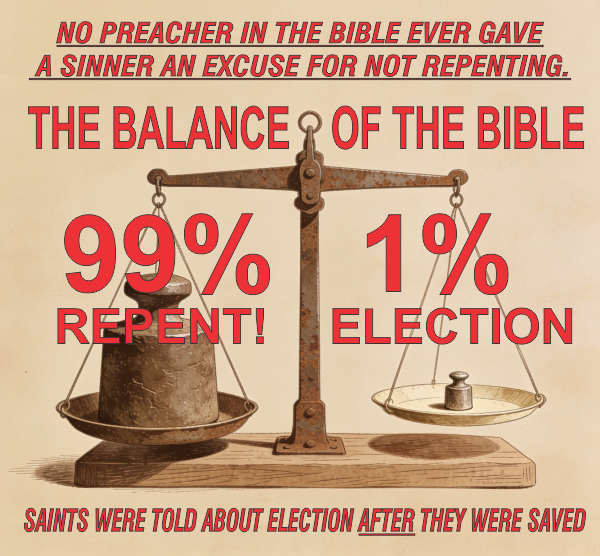
The "New England Way" began with the New England Puritan view of Christian salvation as being a supernatural change of heart and the indwelling of the Holy Spirit. These two doctrines were the cornerstone of their "experiential" Calvinist theology, emphasizing that true faith could not be produced by human will power or mere religious ritual, but required an immediate, supernatural. sovereign act of God. The Puritans rejected the idea of baptismal regeneration (that water baptism saves a person) and instead taught that human nature is entirely corrupted by sin. Because a person is spiritually "dead," salvation requires a supernatural, monergistic act of the Holy Spirit. According to main doctrinal guide for Puritans, the Westminster Confession, The new creature in Christ (2 Corinthians 5:17), is made by regeneration by God’s powerful work of taking away a "heart of stone" and giving a "heart of flesh," spiritually transforming the human will so the saint can freely choose faith and repentance For New England Puritans, the Holy Spirit was not just a theological concept, but an active, personal, immediate presence inside the believer. This idea has been entirely lostto the many denominations perverted by the Scottish Common Sense Realism "verbal restrictive" theory of the Holy Spirit. Puritans believed in the mystical union of God and the saint (1 Corinthians 6:17). This takes place at supernatuiral regeneration, when the Holy Spirit inhabits the saint, and the saint becomes one spirit with God. Jonathan Edwards and his disciples Bellamy, Hopkins and Emmons adapted New England salvation theology to include a distinction between the sinner's natural ability and moral inability to choose God over self. This provided New Light Calvinists the justication to not hesitate to call all sinners to repentance without the caveat that God hade to first regenerate them. The irony is no preacher in the Bible ever cited that caveat when telling sinners to repent.
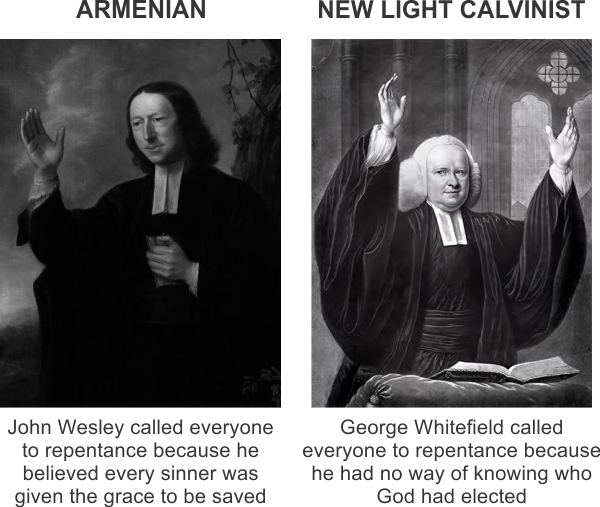
Supernatural regeneration and the indwelling of the Holy Spirit was still necessary for the change of disposition from the born again experience, but by arguing that humans have the natural capacity to believe, but lack the moral desire, New England theologians maintain that God remains fully sovereign in salvation while sinners remain completely responsible for their refusal to repent. This gave New Light Calvinists just as much confidence calling everyone to immediate repentance as Arminian ministers. John Wesley and George Whitefield both believed saving grace was available to anyone who savingly repented of sin and savingly had faith in Christ. But Whitefield and Wesley had two different views of how a sinner savingly repented of sin and savingly had faith in Christ.
|
 |