
How Peter Cartwright
Relates to
the
Heresy of
Decisional Regeneration
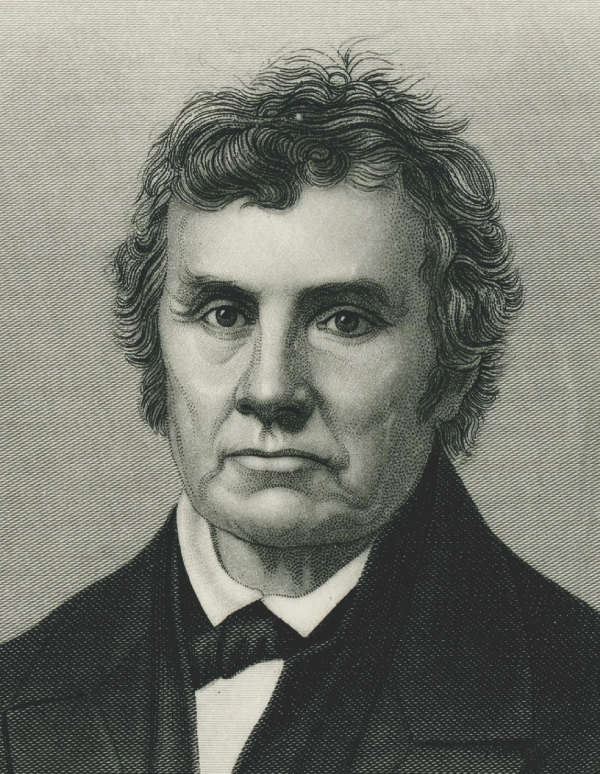 |
Peter Cartwright (1785-1872) |
Peter Cartwright was the most famous Arminian preacher of the Second Great Awakening. His Autobiography, along with Lyle's Diary, can help the modern reader understand what the Second Great Awakening and the Presbyterian Sacramental Meetings (later called Camp Meetings) were like. Cartwright was saved in May of 1801 at a Presbyterian Sacramental Meeting led by James McGready. Here is his account: "The people crowded to this meeting from far and near. They came in their large wagons, with victuals mostly prepared. The women slept in the wagons, and the men under them. Many staid on the ground night and day for a number of nights and days together. Others were provided for among the neighbors around" "The power of God was wonderfully displayed; scores of sinners fell under the preaching, like men slain in mighty battle; Christians shouted aloud for joy. To this meeting I repaired, a guilty, wretched sinner. On the Saturday evening of said meeting I went, with weeping multitudes, and bowed before the stand, and earnestly prayed for mercy. In the midst of a solemn struggle of soul, an impression was made on my mind, as though a voice said to me, "Thy sins are all forgiven thee." Divine light flashed all round me, unspeakable joy sprung up in my soul. I rose to my feet, opened my eyes, and it really seemed as if I was in heaven; the trees, the leaves on them, and every thing seemed, and I really thought were, praising God". He later wrote of the Cane Ridge Presbyterian Sacrametal Meeting where all the miracles took place, "It was supposed that there were in attendance at times during the meeting from twelve to twenty-five thousand people. Hundreds fell prostrate under the mighty power of God, as men slain in battle. Stands were erected in the woods, from which preachers of different Churches proclaimed repentance toward God and faith in our Lord Jesus Christ, and it was supposed, by eye and ear witnesses, that between one and two thousand souls were happily and powerfully converted to God during the meeting". The heavenly fire spread in almost every direction. It was said, by truthful witnesses, that at times more than one thousand persons broke out into loud shouting all at once, and that the shouts could be heard for miles around. From this camp meeting, for so it ought to be called, the news spread through all the Churches, and through all the land, and it excited great wonder and surprise; but it kindled a religious flame that spread all over Kentucky and through many other states... and here our camp meetings (Methodist) took their rise". "As Presbyterian, Methodist, and Baptist ministers all united in the blessed work at this meeting, when they returned home to their different congregations, and carried the news of this mighty work, the revival spread rapidly throughout the land; but many of the ministers and members of the (Presbyterian) synod of Kentucky thought it all disorder, and tried to stop the work. They called their preachers who were engaged in the revival to account, and censured and silenced them". Editors Note: This was because establishment Presbyterian leaders believed the "verbal restrictive" theory of the Holy Spirit which limited the Holy Spirit from acting on sinners and saints immediately. Ever since 1768, when Scottish Common Sense Realism was brought America by John Witherspoon, the College of New Jersey replaced New England Theology with the new doctrine, and it rapidly spread to more schools. The Presbyterian ministers who thought the miracles were of God were censured. This was one of the main reasons Barton W. Stone, Richard McNemar, John Thompson, John Dunlevy , and Robert Marshall left the Kentucky Synod of the Presbyterian Church and formed the Springfield Presbytery, saying they were going to follow the Bible alone. The Springfield Presbytery was dissolved on June 28, 1804 with this Document, The Last Will and Testament of the Springfield Presbytery. Cartwright wrote of other camp meetings, "I have known these camp meetings to last three or four weeks, and great good resulted from them. I have seen more than a hundred sinners fall like dead men under one powerful sermon, and I have seen and heard more than five hundred Christians all shouting aloud the high praises of God at once; and I will venture to assert that many happy thousands were awakened and converted to God at these camp meetings. Some sinners mocked, some of the old dry professors opposed, some of the old starched Presbyterian preachers preached against these exercises, but still the work went on and spread almost in every direction, gathering additional force, till our country seemed all coming home to God". "The jerks were very prevalent. There was a company of drunken rowdies who came to interrupt the meeting. These rowdies were headed by a very large drinking man. They came with their bottles of whisky in their pockets. This large man cursed the jerks, and all religion. Shortly afterward he took the jerks, and he started to run, but he jerked so powerfully he could not get away. He halted among some saplings, and, although he was violently agitated, he took out his bottle of whisky, and swore he would drink the damned jerks to death; but he jerked at such a rate he could not get the bottle to his mouth, though he tried hard. At length he fetched a sudden jerk, and the bottle struck a sapling and was broken to pieces, and spilled his whisky on the ground. There was a great crowd gathered round him, and when he lost his whisky he became very much enraged, and cursed and swore very profanely, his jerks still increasing. At length he fetched a very violent jerk, snapped his neck, fell, and soon expired, with his mouth full of cursing and bitterness". "I always looked upon the jerks as a judgment sent from God, first to bring sinners to repentance; and, secondly, to show professors that God could work with or without means, and that he could work over and above means, and do whatsoever seemeth him good, to the glory of his grace and the salvation of the world. There is no doubt in my mind that, with weakminded, ignorant, and superstitious persons, there was a great deal of sympathetic feeling with many that claimed to be under the influence of this jerking exercise; and yet, with many, it was perfectly involuntary" " It was, on all occasions, my practice to recommend fervent prayer as a remedy, and it almost universally proved an effectual antidote. There were many other strange and wild exercises into which the subjects of this revival fell; such, for instance, as what was called the running, jumping, barking exercise. The Methodist preachers generally preached against this extravagant wildness. I did it uniformly in my little ministrations, and sometimes gave great offense; but I feared no consequences when I felt my awful responsibilities to God". " From these wild exercises another great evil arose from the heated and wild imaginations of some. They professed to fall into trances and see visions; they would fall at meetings and sometimes at home, and lay apparently powerless and motionless for days, sometimes for a week at a time, without food or drink; and when they came to, they professed to have seen heaven and hell, to have seen God, angels, the devil and the damned; they would prophesy, and, under the pretense of Divine inspiration, predict the time of the end of the world, and the ushering in of the great millennium". "This was the most troublesome delusion of all, it made such an appeal to the ignorance, superstition, and credulity of the people, even saint as well as sinner. I watched this matter with a vigilant eye. If I opposed it, I would have to meet the clamor of the multitude; and if any one opposed it, these very visionists would single him out, and denounce the dreadful judgments of God against him. They would even set the very day that God was to burn the world, like the self-deceived modern Millerites. They would prophesy, that if any one did oppose them, God would send fire down from heaven and consume him, like the blasphemous Shakers. They would proclaim that they could heal all planner of diseases, and raise the dead, just like the diabolical Mormons. They professed to have converse with spirits of the dead in heaven and hell, like the modern spirit-rappers. Such a state of things I never saw before, and I hope in God I shall never see again. I pondered well the whole matter in view of my responsibilities, searched the Bible for the true fulfillment of promise and prophecy, prayed to God for light and Divine aid, and proclaimed open war against these delusions". "On Sunday night, when such a tremendous power fell on the congregation, and my gang of rowdies fell by dozens on the right and left, my special persecutor fell suddenly, as if a rifle ball had been shot through his heart. He lay powerless, and seemed cramped all over, till next morning; and about sunrise began to come to. With a smile on his countenance, he then sprang up, and bounded all over the camp-ground, with swelling shouts of glory and victory, that almost seemed to shake the encampment. This was a glorious time for his daughter; she came leaping and skipping to me, and shouted out that those little mean and sickly devils were cast out of her father. He joined the Church, went home, and for days the family did little else but sing, pray, and shout the high praises of God". "The camp meeting lasted eight days and nights; the preachers preached, the power of God attended, sinners by the score fell; the altar, though very large, was filled to overflowing; and while many managed and labored in the altar with mourners, we erected another stand at the opposite end of the encampment, and there the faithful minister proclaimed the word of life. The power of God came there as the sound of a mighty, rushing wind; and such was the effect, that crowds of mourners came forward and kneeled at the benches prepared, and, indeed, the work spread all over the encampment and almost in every tent. There were two hundred and fifty who professed religion". Interaction with a Campbelite who had familiy members who experienced the Holy Spirit. "We had a camp meeting in Adams county, Quincy circuit, and it was numerously attended. There was a gracious work of religion going on among the people, and there was a pretty clever, intelligent old gentleman, who had moved into the settlement from Kentucky, who, in that state, had been a Baptist preacher, but had got his mind confused with Alexander Campbell's dogmas about experimental religion. He had a fine fiimily, and some of them knew what real religion was. He and family attended our camp meeting. He was very fond of argument on almost all theological subjects. He tried to get me into debate during the meeting, but I told him I was there for other and better business" "He denied the operations of the Spirit, its testimony bearing witness with our spirits that we are the children of God; and said all those happy feelings professed by Christians were nothing but excitement; that there was no religion in it...'Sir,' said he, 'it is all delusion; they are not happy'. But, said I, 'your wife and daughter are among the foremost shouters in the crowd. Come,' said I, 'you must come with me to the altar; I want to pray for you there, that you may get religion, and be happy too. Come, sir, I want to see you converted, and shouting-happy.'" " I took him by the arm, to lead him to the altar, but he drew back. I gathered him again, and pulled him along; but the moment he saw his wife and daughter shouting, and making toward him, he tore loose from my grasp, and actually ran. Poor man, he was so confused by fishing in the muddy waters of Campbellism, that he lost his mental balance. He would not yield to the Spirit of God, and submit to be a humble, shouting, happy Christian. Sometimes he would talk rational; sometimes quote, and apply the Scriptures right; then, again, he became skeptical". " But the great difficulty was, the pride of his professed ministerial standing would not let him yield, and renounce his errors. Thus he worried on for a considerable time, and was carried into the whirlpool of doubt and unbelief. His friends talked to him, but talked in vain. He became more and more flighty in his mind, till at length, in a paroxysm of insanity, he shot himself. This event fell like a thunderbolt on his family and the surrounding community; and proves that it is a hard thing to fight against God". Interaction with a Campbelite who tries to stop people from seeking salvation, gets saved, and then drags other Campbellites to the altar. "I started to lead her to the altar, when one of her Campbellite sisters took hold of her, and said, 'What are you going to do?' She said, 'I am going to the altar, to pray for religion.' "0," said the other, 'you have religion. You were baptized, and in that act of obedience your sins were all washed away; and you ought to be satisfied with your religion, and not disgrace your Church by going to a mourners' bench, among the deluded Methodists.' She replied, 'I know I was baptized for the remission of sins, and you all told me that in this act of obedience to Christ I should be forgiven, and be made happy; but I know it is all deception, and false, for I know I have no religion; and I am determined to seek it with these Methodists, for if I die as I am I must be lost forever.' '0,' said the Campbellite lady, 'you must not go.' I then interposed, and said to the lady, 'Let her go. She shall go to the altar if she wants to; and I accordingly led her there. She dropped on her knees, and shortly afterward her husband kneeled at the same altar, with the great deep of his heart broke; and they never rested till they were both soundly converted to God, and were enabled to sing, 'How happy are they, who their Savior obey,' with a zest which they had never felt or enjoyed before". "The work of God went on with great power, and the slain of the Lord were many. Presently, in going through the congregation to hunt up the wounded sinners and lead them to the altar, to my great astonishment and surprise I found my Campbellite lady, who tried to prevent the one I had led to the altar first, sitting down with her face in her hands, and her eyes suffused in tears. She was much agitated. I laid my hand on her shoulder, and said to her, 'Sister, what is the matter? Have these deluded Methodists got hold of you? or have you got a Methodist spasm?": She screamed right out, and said, ' God be merciful to me, a poor, deluded, Campbellite sinner!' '0,' said I, 'will not water save you?' '0, no, no,' she responded; ' I am a poor, deluded sinner, and have no religion, and if I die as I am must be lost, and lost forever. Will you pray for me?' 'Yes,' said I; 'but now you must go to the Methodists' despised mourners' bench.' "With all my heart,' said she; and I partly led and partly carried her there, and if I ever heard a poor sinner plead with God for mercy, she was one". "When it was known that Mrs.________, a Campbellite, was at the mourners' bench, it awfully shocked some of her fellow-members in that watery regiment. She was in such an agony and such good earnest, I almost knew it would not be long till she found the blessing, and while I was leading some other convicted persons to the altar, the Lord powerfully converted this Campbellite heroine. She sprang to her feet, and shouted over the house like a top, and she fell directly to pulling and hauling her Campbellite friends to the Methodist altar, exhorting them to come and get religion, and not for a moment longer to depend on water for salvation, but come and try the Methodist fire, or the fire of the Holy Ghost, and the way she piled up the Campbellite friends at the altar was sublimely awful. After she had got a great number there, she took after her preacher, and exhorted him to come and get religion, 'for,' said she, 'I know you have none,' but he resisted and fled. Several of his members' children had obtained religion, and several more were seeking it...There were over one hundred and twenty professed religion and joined the Methodist Church during this meeting, and, according to niy best recollection, thirteen of them were Campbellites." Methodists gradually stop camp meetings. "I am sorry to say that the Methodist Episcopal Church of late years, since they have become numerous and wealthy, have almost let camp meetings die out. I am very certain that the most successful part of my ministry has been on camp-grounds. There the word of God has reached the hearts of thousands that otherwise, in all probability, never would have been reached by the ordinary means of grace. Their practicability and usefulness have, to some extent, been tested this year, 1856, in my district, Pleasant Plains, and I greatly desire to see a revival of camp meetings in the Methodist Episcopal Church before I go hence and am no more, or before I leave the walls of Zion." Click here to read more of Peter Cartwright's memories of Methodist Camp Meetings. Click here to read Francis Asbury's memories of Methodist Camp Meetings
|