Richard McNemar (1770-1839) |
Richard McNemar with Barton Stone and three other Presbyterian ministers, broke from the Presbyterian Church to form the Springfield Presbytery. He had emigrated to Kentucky from Pennsylvania with Robert Wilkes Finley in 1788, who started the Log Cabin Seminary, and educated future Presyterian ministers, many of which took Scottish Common Sense Realism too far and left the Presbyterian church to become Restorationists. Among these were Richard McNemar, John Thompson, and John Dunlevy, all of which left the Presbyterian Church, forming the Springfield Prebytery, and became Restorationists
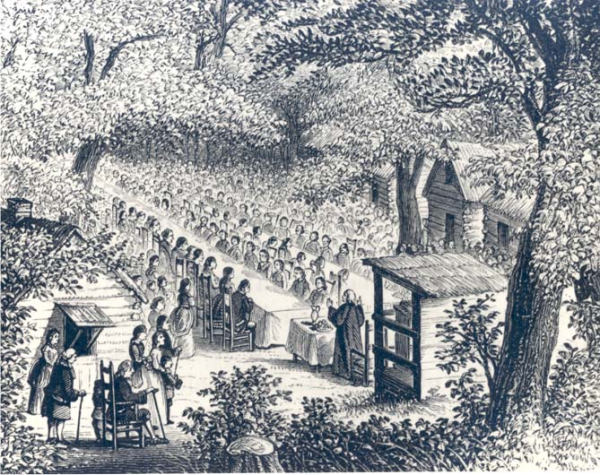
McNemar experienced the Presbyterian Sacramental Meeting revivals first hand. Thousands attended these meetings, some families coming a distance of 50 miles or more. They slept in wagons, tents, and temporary structures. At these meeting hundreds would fall down and lie for long period without moving. There were other strange physical manifestations which increased the excitement and deeply moved the multitude. There were nervous affections which produced horrible convulsions.
These Presbyterian Sacramental Meetings were apposed by many Presbyterian ministers. One Presbyterian minister names John Lyle wrote two journals filled with astounding miracles. The miracles were not welcomed by Presbyterian ministers that believed the popular theory of Scottish Common Sense Realism called the "verbal restrictive theory", which said the Holy Spirit could not affect sinners and saints immediately.
McNemar gives an account of the beginning of these Presbyterian Sacramental Meetings. The first, he says was held at his own church at Cabin Creek, Kentucky, beginning May 22, 1801, and continuing four days and nights. "The scene," he wrote, "was awful beyond description; the falling, the crying out, praying, exhorting, singing, shouting, etc., exhibited such new and striking evidences of a supernatural power that few, if any, could escape without being affected."
The second amazing Presbyterian Sacrmental Meeting was at Concord, Bourbon county, Kentucky in May and June, 1801, when 4000 were said to be present.
The third was at Eagle Creek, in what is now Brown county, Ohio, commencing June 5 and continuing four days and three nights. This was the first Presbyterian Sacramental Meeting held on the north side of the Ohio River. Following this was one in Pleasant Plain, Kentucky, and another at Indian creek, Kentucky.
The largest of these Meetings was at Cane Ridge, near Paris, Kentucky, where it was estimated that there were 20,000 persons on the grounds at one time.
An attendee of one of the Meetings wrote, "Richard McNemar was a man of singular talent, and as a preacher had great power over his congregation. At the old meeting house, in summer, meetings were usually held in a grove and on Sacramental occasions I have seen congregations of two thousand, I should think, gathered around the stand. McNemar would command the closest attention of the whole mass of people, often swaying the multitude as if by magic. On one occasion I witnessed the falling of almost every grown person in a crowded house, and such scenes were not uncommon at the commencement of the revival in this neighborhood."
He becomes a Shaker.
On March 23, 1805, three Shaker missionaries from New Lebanon, N.Y., arrived at the home of McNemar near the Turtle Creek church he pastored. He had never before heard of the Shakers. On April 24, 1805, he joined the Shakers, and nearly all of his large congregation followed his example, and they gave their lands and other property to the church. Thus was founded the largest Shaker community in the West.
McNemar was the first of the former Presbyterian preachers who had been active in the revival to join this strange sect. Soon after, two others, John Dunlevy and Matthew Houston, followed. As the New Lights had nearly worked the destruction of Presbyterianism, now the Shakers greatly weakened the New Lights. McNemar died in the Shaker faith at Union Village, September 15, 1839, aged nearly seventy years. His grave is unmarked. He Was a Presbyterian preacher over six years, a New Light preacher one year and six months and a Shaker thirty-four years.
|