When I wrote The Graham Formula in 2004, I was interested in using Finney as an example of New Light Calvinists of his day who without reservation used the 99% “REPENT!” Scriptures to call sinners to repentance. I wanted modern Christians to see that Finney not only didn’t use anything like a sinners prayer, but would have identified the vast majority of today’s church-goers as false converts. Please read his True and False Conversions. I focused on how Finney taught the complete change that God makes when He regenerates a sinner into a saint.
Modern Calvinists are wrong who say Finney invented the altar call and promoted the heresy of decisional regeneration. I clearly showed in The Graham Formula the evolution of "bare faith" theology after the Civil War, and how Finney had no part in it. The Inquiry Room was used initially to examine penitents for evidence of regeneration, until the BEST system was replaced by the BIST system, and then, at the beginning of the 20th century, Billy Sunday eliminated the Inquiry Room altogether. But I didn't focus on Finney's rational for ignoring what Calvinists call "irresistible grace", even though he had a predeterministic view of God's complete control over sinners and saints.
I give a small sample of his view of election, which is similar to that of Samuel Hopkins, whose New England theology was the most popular among ministers who hadn't been educated in Scottish Common Sense Realism.
"The elect, then, must be those whom God foresaw could be converted under the wisest administration of his government. That administering it in a way that would be most beneficial to all worlds, exerting such an amount of moral influence on every individual, as would result, upon the whole, in the greatest good to his divine kingdom, he foresaw that certain individuals could, with this wisest amount of moral influence, be reclaimed and sanctified, and for this reason, they were chosen to eternal life".
"By this, we are not to understand that he foresaw that some men would be better by nature than others, and that because, on this account, they could be more easily turned to God; but that, upon the whole, they would be so circumstanced that it would be wise in God, in the administration of his government, to bring sufficient moral influence to bear upon them to subdue their opposition, and to save their souls".
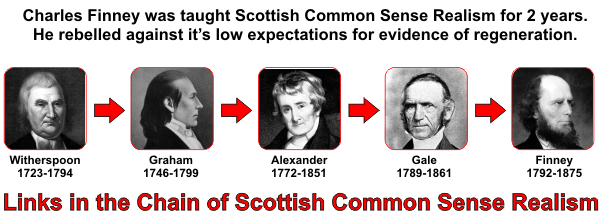
It's unfortunate that Finney was taught Scottish Common Sense Realism by George Gale instead of New England theology. Charles Finney rejected some of the core beliefs held by other New Light Calvinists of his day, but despite this, his ministry to sinners and saints was very effective. Your typical evangelical minister today is far more likely to produce false converts than Finney did in his day. For example, Finney would never tell someone they were saved because they sincerely repeated a salvation prayer, and never told someone they were saved because of something they did. Finney would examine seekers in the inquiry room, and "wrote the book" on true and false conversions.
Finney had the most exterme view of saving repentance of any New Light Calvinist. He told sinners once they knew they were sinners, they were guilty of unbelief until they unconditionally repented and placed entire faith in Christ and what He did.
But, Finney challenged what he thought was the inherent culpability of God in the Calvinist doctrine of irresistible grace, which held that regeneration had to precede saving repentance. This did not mean Finney did not believe in election. His understaning of predetermination was far more advanced than most Calvinist of his day. IT WAS PRECISELY BECAUSE FINNEY BELIEVED IN PREDETERMINATION THAT HE TOOK WHAT WERE UNPOPULAR STANDS ON SO MANY CALVINIST SALVATION ISSUES.
Finney's day, Calvinists typically warned seekers that they wouldn't be able to savingly repent until God had monergistically regenerated their hearts. This gave sinners an excuse for not immediately repenting. Finney saw this as the reason Calvinist ministers couldn't "bear down" on sinners.
As a lawyer, he considered any flaw in the summation of a prosecutor as "wiggle room" for the jury to let a criminal go free. So he shaped his salvation theology to fit what he considered the best arguement for repentance. He told sinners it was entirely their fault for not repenting immediately, something EVERY New Light Calvinist did without altering their salvation theology. Please read Asahel Nettleton's sermon, Genuine Repentance Does Not Precede Regeneration.
Finney used courtroom arguments to strip unrepentant church-goers (the majority of any church) of every excuse for not repenting. Finney felt the sovereignty of God should never be an excuse for sinners to not repent, after all, over 99% of the Bible says "REPENT!", and less than 1% of Scriptures reveal the truth that repentance is a gift of God's grace. No preacher in the Bible, when calling sinners to repentance, ever mentions the sovereignty of God, except to say if they don't repent, God will judge them severely. Preachers in the Bible NEVER tell sinners they can't repent unless God gives them the grace.
John the Baptist: "Repent, for the kingdom of heaven is at hand!” (Matthew 3:2). "Repent, and believe in the gospel" (John 1:15)."Bear fruits worthy of repentance" (John 3:8).
Jesus Christ: "Repent, for the kingdom of heaven is at hand" (Matthew 4:17)."He began to rebuke the cities in which most of His mighty works had been done, because they did not repent" (Matthew 11:20)."Woe to you, Chorazin! Woe to you, Bethsaida! For if the mighty works which were done in you had been done in Tyre and Sidon, they would have repented long ago, sitting in sackcloth and ashes" (Luke 10:13)."The men of Nineveh will rise up in the judgment with this generation and condemn it, because they repented at the preaching of Jonah; and indeed a greater than Jonah is here" (Matthew 12:41, Luke 11:32). "Unless you repent you will all likewise perish" (Luke 13:3, Luke 13:5)."There will be more joy in heaven over one sinner who repents" (Luke 15:7).
"I have not come to call the righteous, but sinners, to repentance" (Luke 5:32)."Repentance and remission of sins should be preached" (Luke 24:47).
The Apostles: "They went out and preached that people should repent" (Mark 6:12).
Paul: "I kept back nothing that was helpful ... testifying to Jews, and also to Greeks, repentance toward God" (Acts 20:20-21)."Repent, turn to God, and do works befitting repentance" (Acts 26:20).:
"The goodness of God leads you to repentance" (Romans 2:4).Paul: "God overlooked, but now commands all men everywhere to repent" (Acts 17:30).
Peter:
"Repent, and let every one of you be baptized in the name of Jesus Christ for the [a]remission of sins" (Acts 2:38)."The Lord is not slack concerning His promise, as some count slackness, but is longsuffering toward us, not willing that any should perish but that all should come to repentance" (2 Peter 3:9).
Before reading what Finney thought about regeneration, let me tell you what the Bible says about regeneration being the monergistic, sovereign work of God. Monergistic means God does it without the cooperation of man.
Four things in the Bible are monergistic:
1) Creation: God spoke the universe into existence out of nothing without human help (Hebrews 11:3).
2) Election: God chose individuals before the foundation of the world according to His own sovereign will (Ephesians 1:4-5).
3) Resurrection: The transformation of saints' bodies from corruptible to incorruptible will be by God’s sovereign power alone (1 Corinthians 15:50).
4) Regeneration: The Scriptures that apply to the resurrection can be applied to regeneration.
1. Spiritual Resurrection (Regeneration) Scripture frequently describes salvation not merely as moral improvement, but as a literal resurrection from spiritual death. In Ephesians 2:1–5, the Apostle Paul states that believers who were "dead in trespasses and sins", God has made "alive together with Christ." A corpse cannot assist in its own resuscitation; likewise, a spiritually dead soul relies entirely on the unilateral, monergistic call of God to receive faith. Ezekiel 36:26: God promises, "I will give you a new heart... I will remove the heart of stone from your flesh and give you a heart of flesh." The recipient of the new heart is completely passive in the surgery.
2. Physical Resurrection: Just as the Holy Spirit enters a spiritually dead heart to grant faith, the Holy Spirit will quicken the saint's physically dead body. John 5:24–25: Jesus Christ unites these two concepts many times in a single sermon. He first speaks of spiritual regeneration: "he who hears My Word... has passed from death into life", and immediately follows it in verses 28–29 by speaking of physical resurrection: "All who are in the graves will hear His voice and come forth". He does it again in John 6:37-39: “All that the Father gives Me will come to Me…I should lose nothing, but should raise it up at the last day”. He does it again in John 6:44: “No one can come to Me unless the Father who sent Me draws him; and I will raise him up at the last day”.
The Apostle Paul unites the two concepts in Romans 8:11: "If the Spirit of Him who raised Jesus from the dead dwells in you, He who raised Christ Jesus from the dead will also give life to your mortal bodies through His Spirit who dwells in you". Regeneration is the down payment on resurrection. Paul does it again a little later in Romans 8:23: “We also who have the firstfruits of the Spirit, even we ourselves groan within ourselves, eagerly waiting for the adoption, the redemption of our body”. In Philippians 3:12-20, Paul says, “I press on, that I may lay hold of that for which Christ Jesus has also laid hold of me…who will transform our lowly body that it may be conformed to His glorious body”.
The Greek word palingenesia is used for the supernatural regeneration of sinners to saints in Titus 3:5: “According to His mercy He saved us, through the washing of regeneration and renewing of the Holy Spirit”, and the supernatural regeneration of the resurrection in Matthew 19:28: “in the regeneration, when the Son of Man sits on the throne of His glory”.
The exact same Holy Spirit who enters a person monergistically when they are supernaturally born again, will supernaturally raise the saint's bodies on the last day.|
Ephesians 2:5: “Even when we were dead in trespasses, (God) made us alive together with Christ (by grace you have been saved)”.
Ephesians 2:8: “by grace you have been saved through faith, and that not of yourselves; it is the gift of God”.
Romans 9:16: “So then it is not of him who wills, nor of him who runs, but of God who shows mercy”.
In Ezekiel 36:26-27, God speaks monergistically: "I will" statements: "I will give you a new heart... I will remove the heart of stone... I will put my Spirit within you, and cause you to walk in my statutes." The Old Testament prophesy was repeated in the New Testament description of regeneration in Hebrews 8:10-11: “I will put my laws into their mind, and write them in their hearts: and I will be to them a God, and they shall be to me a people: And they shall not teach every man his neighbor, and every man his brother, saying, Know the Lord: for all shall know me".
In
Deuteronomy 30:6, the sinner is the recipient of the surgery, not a co-surgeon. "And the Lord your God will circumcise your heart" Like physical circumcision, the spiritual cutting away of the old nature is performed by another party. The Old Testament prophesy was repeated in the New Testament description of regeneration in Romans 2:29: "He is a Jew who is one inwardly; and circumcision is that of the heart, in the Spirit, not in the letter; whose praise is not from men but from God", and Colossians 2:11-13: "In Him you were also circumcised with the circumcision made without hands ... And you, being dead in your trespasses and the uncircumcision of your flesh, He has made alive together with Him".
John 1:12-13: “But as many as received Him, to them He gave the right to become children of God, to those who believe in His name: who were born, not of blood, nor of the will of the flesh, nor of the will of man, but of God”. This explicitly denies human volition as the source of the new birth. John 3:8: Jesus compares the Spirit’s work in regeneration to the wind: "The wind blows where it wishes... So it is with everyone who is born of the Spirit." The wind acts sovereignly, outside human command or cooperation. James 1:18: "Of his own will he brought us forth by the Word of truth". Rebirth originates strictly in the sovereign choice and will of God. Titus 3:5: God saved us "not because of works done by us in righteousness, but according to his own mercy, by the washing of regeneration and renewal of the Holy Spirit."
REGENERATION, taught by Charles Finney in 1849
In the examination of this subject I will--
I. POINT OUT THE COMMON DISTINCTION BETWEEN REGENERATION AND CONVERSION.
II. STATE THE ASSIGNED REASONS FOR THIS DISTINCTION.
III. STATE OBJECTIONS TO THIS DISTINCTION.
IV. SHOW WHAT REGENERATION IS NOT.
V. WHAT IT IS.
VI. ITS UNIVERSAL NECESSITY.
VII. AGENCIES EMPLOYED IN IT.
VIII. INSTRUMENTALITIES EMPLOYED IN IT.
IX. THAT IN REGENERATION THE SUBJECT IS BOTH ACTIVE AND PASSIVE.
X. WHAT IS IMPLIED IN REGENERATION.
XI. PHILOSOPHICAL THEORIES OF REGENERATION.
XII. EVIDENCES OF REGENERATION.
I. I am to point out the common distinction between regeneration and conversion.
1. Regeneration is the term used by some theologians to express the divine agency in changing the heart.
2. With them regeneration does not include and imply the activity of the subject, but rather excludes it. These theologians, as will be seen in its place, hold that a change of heart is first effected by the Holy Spirit while the subject is passive, which change lays a foundation for the exercise, by the subject, of repentance, faith, and love.
3. The term conversion with them expresses the activity and turning of the subject, after regeneration is effected by the Holy Spirit. Conversion with them does not include or imply the agency of the Holy Spirit, but expresses only the activity of the subject. With them the Holy Spirit first regenerates or changes the heart, after which the sinner turns or converts himself. So that God and the subject work each in turn. God first changes the heart, and as a consequence, the subject afterwards converts himself or turns to God. Thus the subject is passive in regeneration, but active in conversion.
When we come to the examination of the philosophical theories of regeneration, we shall see that the views of these theologians respecting regeneration result naturally and necessarily from their holding the dogma of constitutional moral depravity, which we have recently examined. Until their views on that subject are corrected, no change can be expected in their views of this subject. I said in a concluding remark, when upon the subject of moral depravity, that erroneous views upon that subject must necessarily materially affect and modify one's views upon most of the questions in practical theology. Let us bear this remark in mind as we proceed, not only in the discussions immediately before us, but also in all our future investigations, that we may duly appreciate the importance of clear and correct views on the subject of practical theology.
II. I am to state the assigned reasons for this distinction.
1. The original term plainly expresses and implies other than the agency of the subject.
2. We need and must adopt a term that will express the Divine agency.
3. Regeneration is expressly ascribed to the Holy Spirit.
4. Conversion, as it implies and expresses the activity and turning of the subject, does not include and imply any Divine agency, and therefore does not imply or express what is intended by regeneration.
5. As two agencies are actually employed in the regeneration and conversion of a sinner, it is necessary to adopt terms that will clearly teach this fact, and clearly distinguish between the agency of God and of the creature.
6. The terms regeneration and conversion aptly express this distinction, and therefore should be theologically employed.
III. I am to state the objections to this distinction.
1. The original term gennao, with its derivatives, may be rendered, (1.) To beget. (2.) To bear or bring forth. (3.) To be begotten. (4.) To be born, or brought forth.
2. Regeneration is in the Bible the same as the new birth.
3. To be born again is the same thing in the Bible use of the term, as to have a new heart, to be a new creature, to pass from death unto life. In other words, to be born again is to have a new moral character, to become holy. To regenerate is to make holy. To be born of God, no doubt, expresses and includes the Divine agency, but it also includes and expresses that which the Divine agency is employed in effecting, namely, making the sinner holy. Certainly, a sinner is not regenerated whose moral character is unchanged. If he were, how could it be truly said, that whosoever is born of God overcometh the world, doth not commit sin, cannot sin, &c.? If regeneration does not imply and include a change of moral character in the subject, how can regeneration be made the condition of salvation? The fact is, the term regeneration, or the being born of God, is designed to express primarily and principally the thing done, that is, the making of a sinner holy, and expresses also the fact, that God's agency induces the change. Throw out the idea of what is done, that is, the change of moral character in the subject, and he would not be born again, he would not be regenerated, and it could not be truly said, in such a case, that God had regenerated him.
It has been objected, that the term really means and expresses only the Divine agency; and only by way of implication, embraces the idea of a change of moral character and of course of activity in the subject. To this I reply--
(1.) That if it really expresses only the Divine agency, it leaves out of view the thing effected by Divine agency.
(2.) That it really and fully expresses not only the Divine agency, but also that which this agency accomplishes.
(3.) The thing which the agency of God brings about, is a new or spiritual birth, a resurrection from spiritual death, the inducing of a new and holy life. The thing done is the prominent idea expressed or intended by the term.
(4.) The thing done implies the turning or activity of the subject. It is nonsense to affirm that his moral character is changed without any activity or agency of his own. Passive holiness is impossible. Holiness is obedience to the law of God, the law of love, and of course consists in the activity of the creature.
(5.) We have said that regeneration is synonymous in the Bible with a new heart. But sinners are required to make to themselves a new heart (Ezekiel 36:26), which they could not do, if they were not active in this change. If the work is a work of God, in such a sense, that He must first regenerate the heart or soul before the agency of the sinner begins, it were absurd and unjust to require him to make to himself a new heart, until he is first regenerated.
Editor's Note: God alone regenerates who He wishes: "In Him also we have obtained an inheritance, being predestined according to the purpose of Him who works all things according to the counsel of His will" (Ephesians 1:11). God says, "I form the light and create darkness, I make peace and create calamity; I, the Lord, do all these things" (Isaiah 45:7). "A man's heart plans his way, But the LORD directs his steps" (Proverbs 16:9). "Whatever the Lord pleases He does, In heaven and in earth" (Psalms 135:6). Joseph tells his brothers regarding their betrayal, "you meant evil against me; but God meant it for good, in order to bring it about as it is this day, to save many people alive" (Genesis 50:20)."We know that all things work together for good to those who love God, to those who are the called according to His purpose" (Romans 8:28). "The Lord gave, and the Lord has taken away; Blessed be the name of the Lord" (Job 1:21).
Finney cited Ezekiel 36:26 (make yourself a new heart). So did Asahel Nettleton, five times in one sermon you can read here. Once you realize the New Light Calvinist perspective on this subject, you'll no longer object to telling sinners to "make themselves a new heart". Nettleton is perhaps the most respected evangelist of Finney's day.
He told sinners to immediately repent by quoting Ezekiel 36:26: "make yourself a new heart", but he also acknowledged the rest of Ezekiel's prophesies where God says, "I will give you a new heart and put a new spirit in you" Ezekiel 36:26. In fact, its a prophesy of Ezekiel that's the ultimate (and longest) salvation Scripture quoted in the New Testament describing what happens when God regenerates the heart and fills with the Holy Spirit: "I will put my laws into their mind, and write them in their hearts: and I will be to them a God, and they shall be to me a people: And they shall not teach every man his neighbour, and every man his brother, saying, Know the Lord: for all shall know me" (Hebrews 8:10-11).
The New Light Calvinists of Finney's day had no problem telling sinners to make themselves a new heart because they has a consecutional view of repentance. Once you accept the fact that saints had their names written in the Lamb's Book of Life before the foundation of the world (Revelation 13:8, Revelation 17:8), Biblical salvation will make sense to you. But first you must accept by faith, that God "chose us in Him before the creation of the world to be holy and blameless in His sight" (Ephesians 1:4). Paul repeats this theme in the next verse by noting that God predestined us for adoption: God "saved us and called us to a holy calling, not because of our works but because of His own purpose and grace, which he gave us in Christ Jesus before the ages began" (2 Timothy 1:91). Peter addresses believers as those who are "chosen according to the foreknowledge of God the Father" (Peter 1:1-2). To learn more about the rational basis for New Light Calvinist ministers telling sinners to immediately repent and "make yourself a new heart", click here.
Finney also quoted 1 Corinthians 4:15 as a prooftext for regeneration being the result (without the need of irresistable grace) of believing the Gospel: "For though you have ten thousand instructors in Christ Jesus, I have begotten you through the Gospel". He should have considered James 1:18: "Of His own will begat He us with the Word of truth, that we should be a kind of firstfruits of His creatures".
The irresistable grace of regeneration is reinforced in John 3:5-8, Titus 3:5, Ephesians 2:4-5, 1 Peter 1:23, 2 Corinthians 5:17, and John 1:12-13.
While it could be argued that Finney was merely following the lead of every preacher in the Bible by emphasizing the 99% message of the Bible (REPENT!) without the 1% caveat in the Bible of the sovereignty of God and election, he goes too far when he says "Both conversion and regeneration are sometimes in the Bible ascribed to God, sometimes to man, and sometimes to the subject; which shows clearly that the distinction under examination is arbitrary and theological, rather than biblical". This comment is just as illogical as John Calvin's saying the two places in the Bible where it says Pharoah hardened his own heart should be ignored because it says nine times that God hardened Pharoah’s heart. Calvin calls it "a mere cavil" to consider those two scriptures as relevant. There are no "mere cavils" in the Bible. You either believe God put it there for a purpose or you don't.
I don't see any value in commenting on the unbiblical statements made by Charles Finney from this point forward. He has taken the worse parts of Scottish Common Sense Realism, and stropped it of
Regeneration is ascribed to man in the gospel, which it could not be, if the term were designed to express only the agency of the Holy Spirit. "For though ye have ten thousand instructors in Christ, yet have ye not many fathers; for in Christ Jesus I have begotten you through the gospel."--1 Cor. iv. 15.
(6.) Conversion is spoken of in the Bible as the work of another than the subject of it, and cannot therefore have been designed to express only the activity of the subject of it. (1.) It is ascribed to the word of God.--"The law of the Lord is perfect, converting the soul: the testimony of the Lord is sure, making wise the simple."--Ps. xix. 7. (2.) To man. "Brethren, if any of you do err from the truth, and one convert him; let him know, that he which converteth the sinner from the error of his way shall save a soul from death, and shall hide a multitude of sins."--James v. 19, 20.
(7.) Both conversion and regeneration are sometimes in the Bible ascribed to God, sometimes to man, and sometimes to the subject; which shows clearly that the distinction under examination is arbitrary and theological, rather than biblical.
(8.) The fact is, that both terms imply the simultaneous exercise of both human and Divine agency. The fact that a new heart is the thing done, demonstrates the activity of the subject; and the word regeneration, or the expression "born of the Holy Spirit," asserts the Divine agency. The same is true of conversion, or the turning the sinner to God. God is said to turn him, and he is said to turn himself. God draws him, and he follows. In both alike God and man are both active, and their activity is simultaneous. God works or draws, and the sinner yields or turns, or which is the same thing, changes his heart, or, in other words, is born again. The sinner is dead in trespasses and sins. God calls on him, "Awake thou that sleepest, and arise from the dead, and Christ shall give thee light." Eph. v. 14. God calls; the sinner hears and answers, Here am I. God says, Arise from the dead. The sinner puts forth his activity, and God draws him into life; or rather, God draws, and the sinner comes forth to life.
(9.) The distinction set up is not only not recognized in the Bible, but is plainly of most injurious tendency, for two reasons:--
(i.) It assumes and inculcates a false philosophy of depravity and regeneration.
(ii.) It leads the sinner to wait to be regenerated, before he repents or turns to God. It is of most fatal tendency to represent the sinner as under a necessity of waiting to be passively regenerated, before he gives himself to God.
As the distinction is not only arbitrary, but anti-scriptural and injurious, and inasmuch as it is founded in, and is designed to teach, a philosophy false and pernicious on the subject of depravity and regeneration, I shall drop and discard the distinction; and in our investigations henceforth, let it be understood, that I use regeneration and conversion as synonymous terms.
IV. I am to show what regeneration is not.
It is not a change in the substance of soul or body. If it were, sinners could not be required to effect it. Such a change would not constitute a change of moral character. No such change is needed, as the sinner has all the faculties and natural attributes requisite to render perfect obedience to God. All he needs is to be induced to use these powers and attributes as he ought. The words conversion and regeneration do not imply any change of substance, but only a change of moral state or of moral character. The terms are not used to express a physical, but a moral change. Regeneration does not express or imply the creation of any new faculties or attributes of nature, nor any change whatever in the constitution of body or mind. I shall remark further upon this point when we come to the examination of the philosophical theories of regeneration before alluded to.
V. What regeneration is.
It has been said that regeneration and a change of heart are identical. It is important to inquire into the scriptural use of the term heart. The term, like most others, is used in the Bible in various senses. The heart is often spoken of in the Bible, not only as possessing moral character, but as being the source of moral action, or as the fountain from which good and evil actions flow, and of course as constituting the fountain of holiness or of sin, or, in other words still, as comprehending, strictly speaking, the whole of moral character. "But those things which proceed out of the mouth come forth from the heart; and they defile the man. For out of the heart proceed evil thoughts, murders, adulteries, fornications, thefts, false witness, blasphemies."--Matt. xv. 18, 19. "O generation of vipers, how can ye, being evil, speak good things? for out of the abundance of the heart the mouth speaketh. A good man out of the good treasure of the heart bringeth forth good things: and an evil man out of the evil treasure bringeth forth evil things."--Matt. xii. 34, 35. When the heart is thus represented as possessing moral character, and as the fountain of good and evil, it cannot mean,--
1. The bodily organ that propels the blood.
2. It cannot mean the substance of the soul or mind itself: substance cannot in itself possess moral character.
3. It is not any faculty or natural attribute.
4. It cannot consist in any constitutional taste, relish, or appetite, for these cannot in themselves have moral character.
5. It is not the sensibility or feeling faculty of the mind: for we have seen, that moral character cannot be predicated of it. It is true, and let it be understood, that the term heart is used in the Bible in these senses, but not when the heart is spoken of as the fountain of moral action. When the heart is represented as possessing moral character, the word cannot be meant to designate any involuntary state of mind. For neither the substance of soul or body, nor any involuntary state of mind can, by any possibility, possess moral character in itself. The very idea of moral character implies, and suggests the idea of, a free action or intention. To deny this, were to deny a first truth.
6. This term heart, when applied to mind, is figurative, and means something in the mind that has some point of resemblance to the bodily organ of that name, and a consideration of the function of the bodily organ will suggest the true idea of the heart of the mind. The heart of the body propels the vital current, and sustains organic life. It is the fountain from which the vital fluid flows, from which either life or death may flow, according to the state of the blood. The mind as well as the body has a heart which, as we have seen, is represented as a fountain, or as an efficient propelling influence, out of which flows good or evil, according as the heart is good or evil. This heart is represented, not only as the source or fountain of good and evil, but as being either good or evil in itself, as constituting the character of man, and not merely as being capable of moral character.
It is also represented as something over which we have control, for which we are responsible, and which, in case it is wicked, we are bound to change on pain of death. Again: the heart, in the sense in which we are considering it, is that, the radical change of which constitutes a radical change of moral character. This is plain from Matthew xii. 34, 35, and xv. 18, 19, already considered.
7. Our own consciousness, then, must inform us that the heart of the mind that possesses these characteristics, can be nothing else than the supreme ultimate intention of the soul. Regeneration is represented in the Bible as constituting a radical change of character, as the resurrection from a death in sin, as the beginning of a new and spiritual life, as constituting a new creature, as a new creation, not a physical, but a moral or spiritual creation, as conversion, or turning to God, as giving God the heart, as loving God with all our heart, and our neighbour as ourselves. Now we have seen abundantly, that moral character belongs to, or is an attribute of, the ultimate choice or intention of the soul.
Regeneration then is a radical change of the ultimate intention, and, of course, of the end or object of life. We have seen, that the choice of an end is efficient in producing executive volitions, or the use of means to obtain its end. A selfish ultimate choice is, therefore, a wicked heart, out of which flows every evil; and a benevolent ultimate choice is a good heart, out of which flows every good and commendable deed.
Regeneration, to have the characteristics ascribed to it in the Bible, must consist in a change in the attitude of the will, or a change in its ultimate choice, intention, or preference; a change from selfishness to benevolence; from choosing self-gratification as the supreme and ultimate end of life to the supreme and ultimate choice of the highest well-being of God and of the universe; from a state of entire consecration to self-interest, self-indulgence, self-gratification for its own sake or as an end, and as the supreme end of life, to a state of entire consecration to God, and to the interests of his kingdom as the supreme and ultimate end of life.
VI. The universal necessity of regeneration.
1. The necessity of regeneration as a condition of salvation must be co-extensive with moral depravity. This has been shown to be universal among the unregenerate moral agents of our race. It surely is impossible, that a world or a universe of unholy or selfish beings should be happy. It is impossible that heaven should be made up of selfish beings. It is intuitively certain, that without benevolence or holiness no moral being can be ultimately happy. Without regeneration, a selfish soul can by no possibility be fitted either for the employments, or for the enjoyments, of heaven.
2. The scriptures expressly teach the universal necessity of regeneration. "Jesus answered and said unto him, Verily, verily, I say unto thee, Except a man be born again, he cannot see the kingdom of God."--John iii. 3. "For in Christ Jesus neither circumcision availeth any thing, nor uncircumcision, but a new creature."--Gal. vi. 15.
VII. Agencies employed in regeneration.
1. The scriptures often ascribe regeneration to the Spirit of God. "Jesus answered, Verily, verily, I say unto thee, Except a man be born of water and of the Spirit, he cannot enter into the kingdom of God. That which is born of the flesh is flesh; and that which is born of the Spirit is spirit."--John iii. 5, 6. "Which were born, not of blood, nor of the will of the flesh, nor of the will of man, but of God."--John i. 15.
2. We have seen that the subject is active in regeneration, that regeneration consists in the sinner changing his ultimate choice, intention, preference; or in changing from selfishness to love or benevolence; or, in other words, in turning from the supreme choice of self-gratification, to the supreme love of God and the equal love of his neighbour. Of course the subject of regeneration must be an agent in the work.
3. There are generally other agents, one or more human beings concerned in persuading the sinner to turn. The Bible recognizes both the subject and the preacher as agents in the work. Thus Paul says: "I have begotten you through the gospel." Here the same word is used which is used in another case, where regeneration is ascribed to God.
Again: an apostle says, "Ye have purified your souls by obeying the truth." Here the work is ascribed to the subject. There are then always two, and generally more than two agents employed in effecting the work. Several theologians have held that regeneration is the work of the Holy Spirit alone. In proof of this they cite those passages that ascribe it to God. But I might just as lawfully insist that it is the work of man alone, and quote those passages that ascribe it to man, to substantiate my position. Or I might assert that it is alone the work of the subject, and in proof of this position quote those passages that ascribe it to the subject. Or again, I might assert that it is effected by the truth alone, and quote such passages as the following to substantiate my position: "Of his own will begat He us with the word of truth, that we should be a kind of first-fruits of his creatures."--James i. 18. "Being born again, not of corruptible seed, but of incorruptible, by the word of God, which liveth and abideth for ever."--1 Peter i. 23. The fact is, when Dr. Woods and others insist that regeneration is the work, or a work of God, they tell the truth, but not the whole truth. For it is also the work of man and of the subject. Their course is precisely like that of the Unitarian, who when he would prove that Christ is not God, merely proves that he was a man. Now we admit that he was a man, but we hold that he is more, that he is also God. Just so we hold that God is active in promoting regeneration, and we hold also that the subject always and necessarily is active in the work, and that generally some other human agency is employed in the work, in presenting and urging the claims of God.
It has been common to regard the third person as a mere instrument in the work. But the fact is, he is a willing, designing, responsible agent, as really so as God or the subject is.
If it be inquired how the Bible can consistently ascribe regeneration at one time to God, at another to the subject, at another to the truth, at another to a third person; the answer is to be sought in the nature of the work. The work accomplished is a change of choice, in respect to an end or the end of life. The sinner whose choice is changed, must of course act. The end to be chosen must be clearly and forcibly presented: this is the work of the third person, and of the Holy Spirit. The Spirit takes of the things of Christ and shows them to the soul. The truth is employed, or it is truth which must necessarily be employed, as an instrument to induce a change of choice. See this illustrated in Sermons on Important Subjects, Sermon I. on Regeneration.
VIII. Instrumentalities employed in the work.
1. Truth. This must, from the nature of regeneration, be employed in effecting it, for regeneration is nothing else than the will being duly influenced by truth.
2. There may be, and often are, many providences concerned in enlightening the mind, and in inducing regeneration. These are instrumentalities. They are means or instruments of presenting the truth. Mercies, judgments, men, measures, and in short all those things that conduce to enlightening the mind, are instrumentalities employed in effecting it.
Those who hold to physical or constitutional moral depravity must hold, of course, to constitutional regeneration; and, of course, consistency compels them to maintain that there is but one agent employed in regeneration, and that is the Holy Spirit, and that no instrument whatever is employed, because the work is, according to them, an act of creative power; that the very nature is changed, and of course no instrument can be employed, any more than in the creation of the world. These theologians have affirmed, over and over again, that regeneration is a miracle; that there is no tendency whatever in the gospel, however presented, and whether presented by God or man, to regenerate the heart. Dr. Griffin, in his Park Street Lectures, maintains that the gospel, in its natural and necessary tendency, creates and perpetuates only opposition to, and hatred of God, until the heart is changed by the Holy Spirit. He understands the carnal mind to be not a voluntary state, not a minding of the flesh, but the very nature and constitution of the mind; and that enmity against God is a part, attribute, or appetite of the nature itself. Consequently, he must deny the adaptability of the gospel to regenerate the soul. It has been proclaimed by this class of theologians, times without number, that there is no philosophical connexion between the preaching of the gospel and the regeneration of sinners, no adaptedness in the gospel to produce that result; but, on the contrary, that it is adapted to produce an opposite result. The favourite illustrations of their views have been Ezekiel's prophesying over the dry bones, and Christ's restoring sight to the blind man by putting clay on his eyes. Ezekiel's prophesying over the dry bones had no tendency to quicken them, they say. And the clay used by the Saviour was calculated rather to destroy than to restore sight. This shows how easy it is for men to adopt a pernicious and absurd philosophy, and then find, or think they find, it supported by the Bible. What must be the effect of inculcating the dogma, that the gospel has nothing to do with regenerating the sinner? Instead of telling him that regeneration is nothing else than his embracing the gospel, to tell him that he must wait, and first have his constitution recreated before he can possibly do anything but oppose God? This is to tell him the greatest and most abominable and ruinous of falsehoods. It is to mock his intelligence. What! call on him, on pain of eternal death, to believe; to embrace the gospel; to love God with all his heart, and at the same time represent him as entirely helpless, and constitutionally the enemy of God and of the gospel, and as being under the necessity of waiting for God to regenerate his nature, before it is possible for him to do otherwise than to hate God with all his heart?
IX. In regeneration the subject is both passive and active.
1. That he is active is plain from what has been said, and from the very nature of the change.
2. That he is, at the same time, passive, is plain from the fact that he acts only when and as he is acted upon. That is, he is passive in the perception of the truth presented by the Holy Spirit. I know that this perception is no part of regeneration. But it is simultaneous with regeneration. It induces regeneration. It is the condition and the occasion of regeneration. Therefore the subject of regeneration must be a passive recipient or percipient of the truth presented by the Holy Spirit, at the moment, and during the act of regeneration. The Spirit acts upon him through or by the truth: thus far he is passive. He closes with the truth: thus far he is active. What a mistake those theologians have fallen into who represent the subject as altogether passive in regeneration! This rids the sinner at once of the conviction of any duty or responsibility about it. It is wonderful that such an absurdity should have been so long maintained in the church. But while it is maintained, it is no wonder that sinners are not converted to God. While the sinner believes this, it is impossible, if he has it in mind, that he should be regenerated. He stands and waits for God to do what God requires him to do, and which no one can do for him. Neither God, nor any other being, can regenerate him, if he will not turn. If he will not change his choice, it is impossible that it should be changed. Sinners who have been taught thus, and have believed what they have been taught, would never have been regenerated had not the Holy Spirit drawn off their attention from this error, and ere they were aware, induced them to close in with the offer of life.
X. What is implied in regeneration.
1. The nature of the change shows that it must be instantaneous. It is a change of choice, or of intention. This must be instantaneous. The preparatory work of conviction and enlightening the mind may have been gradual and progressive. But when regeneration occurs, it must be instantaneous.
2. It implies an entire present change of moral character, that is, a change from entire sinfulness to entire holiness. We have seen that it consists in a change from selfishness to benevolence. We have also seen that selfishness and benevolence cannot co-exist in the same mind; that selfishness is a state of supreme and entire consecration to self; that benevolence is a state of entire and supreme consecration to God and the good of the universe. Regeneration, then, surely implies an entire change of moral character.
Again: the Bible represents regeneration as a dying to sin and becoming alive to God. Death in sin is total depravity. This is generally admitted. Death to sin and becoming alive to God, must imply entire present holiness.
3. The scriptures represent regeneration as the condition of salvation in such a sense, that if the subject should die immediately after regeneration, and without any further change, he would go immediately to heaven.
Again: the scripture requires only perseverance in the first love, as the condition of salvation, in case the regenerate soul should live long in the world subsequently to regeneration.
4. When the scriptures require us to grow in grace, and in the knowledge of the Lord Jesus Christ, this does not imply that there is yet sin remaining in the regenerate heart which we are required to put away only by degrees. But the spirit of the requirement must be, that we should acquire as much knowledge as we can of our moral relations, and continue to conform to all truth as fast as we know it. This, and nothing else, is implied in abiding in our first love, or abiding in Christ, living and walking in the Spirit, &c. |